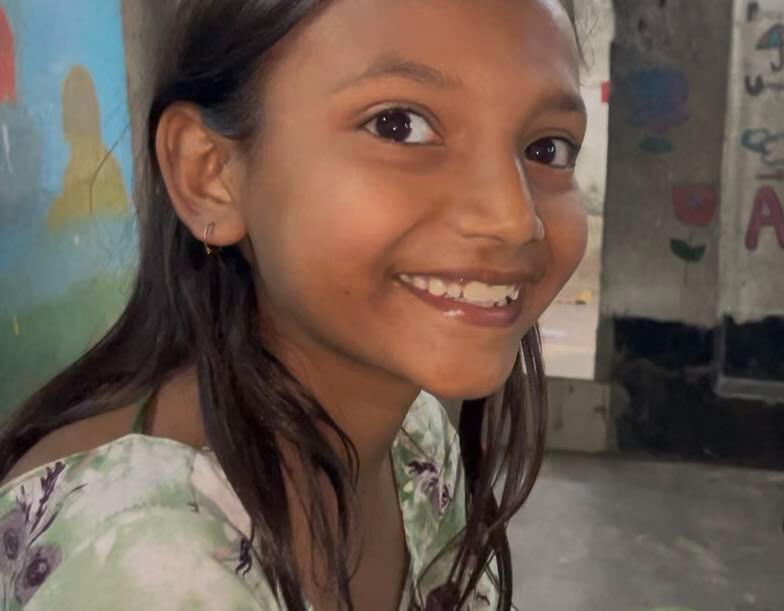
Joy in the Dying City
A campaign for Tiljala SHED, an Indian NGO that is empowering slum communities in Calcutta
1. Sad Home: The Search for PrivacyA decade of drug and alcohol abuse had left its mark on him.Just minutes after Aliha began telling me about the grief he had caused her, there he was: her husband, the addict. I caught only a glimpse of him: stooped silent gait, black hair silvering to steel, vacant eyes. Bottle of liquor in tow. He drifted past us without a word and slipped into the cramped hut where his family - all six members - lived together, stumbling distance from the putrid sewage canal that rims their slum.Concerned, I asked whether we should move the interview elsewhere. But Aliha told me not to worry. “He’s in a world of his own,” she said. She was right; he paid us no mind. This was one of his good days.But on bad days, he beats her and the four children. He spends what little money he can get on liquor and heroin. He deprived his family of their eligibility for government food rations after he tore up their legal documents in a drug-fueled craze. He litters their home with street trash, convinced in his addled mind that it’s money. The man is out of his mind.So just to be safe, we relocated to the school center down the road, to continue the interview in privacy: Aliha, her fourteen-year-old son, Rahul, the translator, the social worker, and I. The school was a concrete room with a slanted floor; it inches downward to the fetid canal with every rainstorm. On the classroom walls hung a blackboard, the students’ drawings, and a sign bearing motivational messages like:BE POSITIVE
I’M POSSIBLE
KEEP DOING HARD WORKAnd hard work has defined young Rahul’s existence. He wakes at 4:00 AM to sell vegetables with Aliha before school. He studies diligently, despite the chaos of his home life. He understands that education holds the keys to a brighter future for himself and his mother, whose worsening respiratory ailment might prevent her from working - or even claim her life. And Rahul’s concern for others isn’t limited to his family. If he hears a neighboring woman yelling because her husband is beating her, he runs in to help - and his courage is rewarded with knocks to the head. I struggled to imagine this thin boy, who looks ten from malnutrition even though he’s fourteen, throwing himself in front of a grown man.This is his life.And this is why, after my interview with Rahul and Aliha (whose names I’ve altered for anonymity), I needed somewhere to weep.So I stepped outside for some space and privacy. But space and privacy do not exist in the slums. Every square inch here is claimed. Small shanties for big families, goats tethered to cinderblocks, rickshaws, cookingware stacked or scattered. Heaps of trash in the process of being sorted and sold. Bamboo pipes discharging human waste into the canal. And the human beings themselves, who are born, work, and die here. They are everywhere, pushing through crowded streets, peering out of huts, yelling out of car windows. Space, solitude, and the kind of inner expansiveness they make possible - these are luxuries in short supply.I ducked down a narrow lane, excusing myself as I squeezed by the boy who’d offered me the middle finger an hour before. I made my way behind the school center where I finally found myself alone. It was a lovely day. The tropical sun beamed through the city smog, and the rain had washed the layer of brown dust off the leaves. Tangerine-colored tree blossoms swayed as white birds perched in them. Below, the canal oozed by.I sat on a mound of trash and began to weep, thinking of Rahul, Aliha, and the untold others who face extreme hardship in communities like this. It was a relief to let out the pressure that had been building within me all during the interview. But my privacy lasted seconds.“Sir?” came a young voice. A girl two huts down, washing cookingware. She smiled shyly. I waved her off and cradled my head in my hands.But there is no escaping the children of India. They are everywhere; they flow over the streets like monsoon rains, they pour down the banks, they bear you away in the tide of their giggles and shrieks. On my other side now, three more of them, ten years old, flashing bright buckteeth. All I’d wanted was to cry in peace, and instead I found myself surrounded.“Sir?” one of them asked, a girl, offering me one of the handful of English words she knew. They all wanted to know why I’d flown across the world just to emote to the garbage. But how could I explain myself? Even if I could speak Bengali, the local language, how does a thirty-one-year-old man explain to slum children that their condition makes him weep?“You sad, sir?” she continued. Evasion was no longer possible; I resigned myself to the fact that I would have no privacy. So I looked up at her and nodded, then pointed - in an attempt at explanation - at the trash, the canal, the row of shanties stretching along its banks as far as the eye could see. Had he been there, I would have gestured also at the wraith of a man that Rahul calls father, remembering the sight of him earlier that afternoon, whiskey in hand, dreaming his dark dreams.My gestures made things clear to the girl. Young as she was, she understood enough of the world to know that people who look like me are not permitted to live in conditions like this, and that we find them heart-rending.“Sad home?” she asked, nodding and pointing to the huts, one of which she called home.Sad home. A more desolate description of this broken community would be impossible. And it was made all the more poignant by the fact that it was said in a child’s broken English.“Yes,” I nodded, my eyes swimming. “Sad home.”2. Kolkata: The City of Joy and DyingYou probably know the city of Kolkata by its former name, Calcutta. It lies sixty miles upriver from the vast mangrove swamps along the Bay of Bengal, in the tropical floodplains of east India. Kolkata was the capital of British India until 1911, and while the city is famed for its historical and cultural richness, it is also notorious for its poverty. The condition of the city’s destitute so shocked one Western visitor that she dedicated her life to ministering to their needs. In 1950, she founded the Missionaries of Charity and came to be known the world over as Mother Teresa.While poverty decreased over subsequent decades, Kolkata still lagged behind other major Indian cities. Years of withering industries and economic stagnation led India’s Prime Minister Rajiv Gandhi pronounced Kolkata to be a “dying city” in 1985.But the very same year, the city received a different nickname, still used today: “The City of Joy.” This came from the title of a novel by French writer Dominique Lapierre, set in the region.The city of joy and dying. During my week in Kolkata, I witnessed both. In the one hour I spent visiting Mother Teresa’s Home for the Destitute, I saw a man - newly dead - carried past on a stretcher, hastily wrapped in a white shroud. I watched a limbless child being pushed in a cart, begging for pocket change. And my presence as an amateur journalist sparked a death threat.But I also saw complete strangers beckoning me to join their table for an outdoor Ramadan meal. Children dancing on the roof of a van. And I can’t forget the game of telephone where one clever girl tricked me into whispering “I love you” into her ear, not knowing what the Bengali sounds meant until it was too late.Joy and dying - these two mingle with an easy familiarity here, like the whirl of odors you catch in the streets: pineapple and sewage, diesel and hot chai. Or like the boys in white caps walking home from the mosque, arms draped affectionately over each other’s shoulders, discoursing excitedly on God and girls.Shortly after Kolkata received these two contrary nicknames, the NGO Tiljala SHED was founded. Tiljala is the slum neighborhood in Kolkata where the organization began its outreach, and SHED stands for Society of Human and Educational Development. It was founded in 1987 by Mohammed Alamgir, the first person from the Tiljala slum to receive a law degree, and is now led by his son, Shafkat Alam.The organization’s three main programs of outreach are education, livelihood, and rights and entitlements. Many of their beneficiaries are “rag pickers,” a term for people who pick waste from the city’s streets and rubbish heaps in search of reusable materials like plastic and aluminum. They then sell these to recyclers for $2-$4 USD per day, which yields the purchasing power of about $350 per month in an average American city. Tiljala SHED also focuses particularly on empowering women and girls, and in 2015, Shafkat represented the organization as a delegate to the United Nations’ Commission on the Status of Women.This NGO is doing immensely important work for some of India's most underprivileged people. But their ability to continue this work is precarious. They are donor-funded, and their current round of long-term funding is set to expire in June of 2026. Funding is a constant source of anxiety for Shafkat and his staff, but just one long-term grant could give them room to breathe and time to focus all their efforts on their beneficiaries. 80% of all donations to Tiljala SHED go directly to their programs, in accordance with India’s FCRA law; the remainder is set aside for overhead costs such as office rent and administrators’ salaries.3. Fire Island: Conditions in the SlumsWe piled into the cramped van - Shafkat, the social workers, and I - and rode into the whirlwind: Indian traffic. The streets were thronged with innumerable pedestrians, two-wheeled rickshaws, three-wheeled tuk-tuks, pickup trucks with what looked like entire family trees jostling in the bed. The backs of the garish buses bore the reassuring half-rhyme “SAFE DRIVE SAVE LIFE,” and their commitment to sane driving proved to be commensurate with their commitment to poetic excellence.It was a cacophony. Everybody was honking, as if what really spun the wheels were a fist on the horn and not a foot on the pedal. The “No Honking” signs were disregarded as cheerfully as the basic traffic rules; the driving lanes were polite suggestions at best, probably because the painted lines demarcating them could seldom be seen beneath the armada of scooters that claimed them as private, narrow thoroughfares. Our van swerved and screeched. I aged ten years in two miles.We arrived, somehow intact. I followed Shafkat and the others behind a row of food stalls, where a few men were lounging in the shade of a parked bus, playing cards beside a pack of shabby stray dogs.Suddenly, my eyes began to water: the chemical stench. A sewage canal flowed by, carrying, among God knows what else, the waste from upstream leather processing units. This untreated canal fed a river that opened into the Bay of Bengal. I watched a man dump a bucket of trash into it. As the water passed under a nearby footbridge, it threw up a fine, miasmic spray; a kind of aromatic portal to walk through, greeting you as you pass over the footbridge and into the slum.We passed over the footbridge to a narrow island in the canal, thirty feet wide, half a mile long, and densely populated. 1,200 families live here, in the slum known as Topsia. (I follow Tiljala SHED in using “Topsia” to refer to this slum community, which is also known as Mazdoor Para, and not to the larger neighborhood, named Topsia, in which the slum is located.)A narrow, dusty lane ran the length of the slum island. On either side were shanties, ten feet wide and fifteen feet deep, packed next to each other for the entire half-mile. Each hut enclosed a single room dominated by a bed, sometimes with a loft for additional sleeping or storage. There were no windows or ventilation. The heat was tolerable when I visited in February, but by May it gets stifling. In the back of the huts, overlooking the canal, was a rickety porch which served as bath and bathroom, with bamboo pipes for plumbing. Stand on the canal banks at a certain angle, and you can see the pipes sticking out in an endless, tapered line, like a panflute out of Dante’s Inferno.There used to be a second footbridge, but it was destroyed by a cyclone, making it still harder for the people of Topsia to escape this slum island and the foul waters surrounding it.We passed a woman working a rusty water pump. Out poured the canal water into a bucket, which she and her neighbors use to wash their clothes. This can cause skin diseases, even though they stir in soap liberally. For drinking water, they queue up with their plastic barrels at the pumping station, where the government releases water twice a day. Between waiting, filling, and carrying the water back on foot, the process can take them up to two hours. I watched three-year olds waddle down the lane, carrying water jugs half their size.But Topsia was also as colorful as it was dilapidated. Floral sarees and hijabs hung on clothes lines by brightly painted doors. Shining plastics and tarps were wrapped around the exterior of the huts for insulation. Children sat on mats trimming red and blue flip-flops; cutting 20 thongs earns them 3 cents. White and brown goats sunned themselves on doorsteps, eyeing me sleepily.The lane was too narrow for cars, which lent Topsia a welcome quiet, compared with the din of Kolkata traffic that rang through the streets just across the canal. Children ran up and down the lane without fear of being hit. But they faced other dangers. Until thirteen years ago, there were three heroin dens on the island. I spoke to one Tiljala SHED student, Anjum Khan, who recalled walking past them as a little girl and seeing children and young men shooting up inside. Young girls would sell bracelets just to get a fix. But with Tiljala SHED’s support, the community organized a sting operation, and the dens haven’t returned since.We entered the school center. “Good afternoon, sir!” They greeted me excitedly, two dozen young children sitting cross-legged on the rug, their notebooks open on their laps. I attempted to respond; they giggled at my botched Bengali.Like the huts, the school’s roof was made of tin and supported by a bamboo frame; its walls were brick. Covering them were the English alphabet, a diagram showing human anatomy, and - a delightful surprise - a plump beaming Santa. In the school’s little courtyard grew one of the few trees I saw on the island, dousing the dusty ground in a green shade. Though modestly sized, the school offers the students something that is in extreme scarcity in slums like Topsia: space. They have none of this in their homes, which they share with six other people on average. Siblings jostle by them on their way in and out; they have to push past the occasional goat; they’re kept awake all night by the crying newborn across the lane. Home for them is not a place where young, distractible minds can focus on their studies for any length of time. The very word “school” comes from the Greek for leisure. The connection between education and luxury had never been more evident to me.Of Tiljala SHED’s seven school centers, this one in Topsia is the oldest, constructed in 1996. Perhaps as a result of the NGO’s longer presence here, Topsia had a friendlier atmosphere than the other communities I visited. The education offered is supplementary, to give students additional attention after the standard school day spent in crowded government schools. Younger children are taught in the afternoon, adolescents in the evening - the rationale being to keep the latter away from trouble after dark. Subjects include English, Bengali, math, and computer skills. Extracurriculars include taekwondo, Indian dance, drawing, and guitar. Tiljala SHED also organizes trips to waterparks and overnight camps. I met a number of students who spoke excitedly of seeing the ocean for the first time.***Dusk had fallen and the mothers were preparing dinner outside their huts. Although these have electric fans and lightbulbs, there are no stoves, and most people cook with wood-fired ovens. Sometimes, homes catch fire; in these cramped conditions, fire spreads. There have been five conflagrations in the past ten years. The most recent, in December of 202
**When the fire broke out, the fire department, though located nearby, was slow in arriving, in part because the trucks couldn’t fit through the narrow lane. So they had to spray canal water from the opposite banks. The government’s assistance to those who’d lost their homes? Two bamboo poles and a sheet of plastic. Tiljala SHED’s assistance? For an entire month, staff and volunteers worked with the affected families, providing three meals a day, then dry rations. They resupplied them with essentials like blankets, clothing, and notebooks for the students, until the families were able to rebuild their huts or find permanent housing.This is why Topsia needs non-governmental organizations like Tiljala SHED. They cannot rely on the government for basic assistance, when disasters like this - to which their living conditions lead - inevitably strike.4. Death Threat: Domestic AbuseAs grim as the situation is in Topsia, the slum in Narkeldanga is even worse. (As with Topsia, I follow Tiljala SHED in referring to this slum as Narkeldanga, after the name of the larger neighborhood in which it’s located.) Narkeldanga used to be the semi-rural edge of Kolkata, a transition area between the city and the rice fields stretching beyond. Coconut palms swayed on the old plantations, giving the neighborhood its name: “narkel” means coconut in Bengali. But the similarity with “narcotic” is bitterly apt. Drug use in Narkeldanga is high, and it’s the most impoverished and dangerous slum that Tiljala SHED serves. The NGO’s social worker assigned to this neighborhood, Sreema, has been mugged here twice. Some residents live in near-starvation conditions. Like Topsia, Narkeldanga fronts a nauseating canal, but unlike Topsia, which has an undeniable festiveness, the energy in Narkeldanga is tense. This slum is home to Rahul and his mother, Aliha, and it’s where I found myself, after our interview, weeping atop that trash mound.While I sat hunched by the canal, I was evidently seen weeping by still more children than those who had spoken to me. They ran inside the school center where Prosen, my translator, and Sreema, the social worker, were waiting, in order to ask them what was going on with me. Word gets around quickly here.When I returned to the classroom, still visibly shaken, Sreema gently told me (via Prosen) that she was concerned about me. Rahul’s interview had been difficult, no doubt, but the interview scheduled for tomorrow, she said, would be even more heart-rending. I was willing to conduct it anyway, but was prevented from doing so by an unexpected inconvenience: a death threat.The woman whom I was to interview, as I learned the next day, had been warned by her husband that he would kill her if she spoke to me. Evidently, children weren’t the only ones who had found out about my presence here. Again, there is no privacy in the slums - not for me, and certainly not for this woman.Sreema thought this threat was certainly bluster, but she added that the man in question was extremely violent. Unlike Rahul's father, this man still had his wits about him - enough to know that his domestic tyranny was at risk, but still determined to never relinquish it. His beatings had grown only more frequent now that he'd detected a growing sense of empowerment among the women in the community. Tiljala SHED was about to form a third female Self-Help Group in Narkeldanga, which Aliha - Rahul’s mother - would join. But this man had forbidden his wife, on pain of even more severe beatings, from joining it. “If his wife gets the - what do you say? - the confidence to stand up to him, he is in for a bad day,” Sreema said. “He wants his wife to be under his control.”I asked Sreema why the woman hadn’t left him. She responded that the woman perceived her present situation to be the lesser of two evils. She had received no education and knew little of the world outside Narkeldanga. All she knew was that out on her own, she risked getting forced into prostitution, or raped, or murdered. With her husband, as bad as he was, at least she had a roof over her head, a stable income, and Tiljala SHED. Leaders in the community, who knew about her situation, had threatened the abusive husband with police action. But only as a mitigation tactic. Domestic violence laws aren’t strong here; as Prosen put it, “People suffer in silence.” The jails - like everything else here - are already crowded, and if anyone sent him there, he’d just be back a week later and even angrier.As appalling as this woman’s circumstances were, one can find some encouragement in the knowledge that reports of domestic abuse have decreased significantly in recent years, since Tiljala SHED started ramping up its Self-Help Groups for wives and mothers. If a woman is heard yelling because her husband is beating her, ten neighboring women from the group will rush to confront him. In this situation, it’s often better for women to offer assistance than men, because men are more likely to cause the fight to escalate further. And the husband rarely lays a hand on any of these women, because he knows he’d have their husbands to contend with later.5. Treasure Trash: The Rag PickersThough Sheik Moidul (34) no longer works as a rag picker, he still campaigns for their welfare. He has advocated for rag-pickers in cities across India and has been interviewed over fifty times.Moidul (as he prefers to be called) started rag picking after he was orphaned at age seven. Though he was supported by the income that his blind grandmother scraped together from begging, he is proud of the fact that he himself has never accepted a handout.Rag pickers begin their days early, sometimes at 3:00 AM, to get to the more valuable materials like copper before anyone else. Their work offers them little but tedium and health hazards. They pick the trash with bare hands because gloves slow them down, so that sometimes they contract skin diseases. And even though they’re inhaling fumes, they can’t afford to buy masks, with the result that respiratory illnesses are not uncommon.Moidul said that the social stigma endured by rag pickers was very severe during his childhood. People would call them kachra, “waste.” They would refuse to serve them at tea stalls. Police would harass them. And they were subjected to all of this while earning just $4 USD daily.But today, the perception of rag pickers has improved. More people regard them as sanitation workers than social pariahs, and they recognize their valuable service to the city. Moidul’s advocacy, along with the help of Tiljala SHED, has been instrumental in bringing about that change.Tiljala SHED facilitated the formation of the Association of Rag Pickers, which was registered in 2000 and lobbied successfully for rag pickers to be included in Kolkata’s social security programs. Tiljala SHED has also managed to get rag pickers - most of whom live in shanties without legally recognized addresses - a means of getting government IDs, which are necessary for voting and food rations. And in 2012, the NGO helped Moidul secure a loan for a rickshaw, which is how he now supports his family of four, his days of digging through trash behind him.6. One Year’s Wages in a Single Day: Child TraffickingBack on the island slum of Topsia, I received an unexpected proposition. A crowd had gathered around me, mostly mothers and children, and everyone was surprised to learn that I remained unmarried at age thirty-one. But Aziza (32, whose name I’ve altered for anonymity) laughed and said that staying single was a wise decision on my part, since marriage wasn’t worth the headache. She then gestured at a woman in her fifties who was nicknamed Nani (which means “Grandma”) and missing half of her teeth.“Nani is single,” Aziza said, and asked jokingly whether I’d like to marry her. I’d come to India for a number of reasons, but marriage wasn’t one of them. Caught off-guard, I smiled nervously and mumbled something about being too high-maintenance. My bride-to-be ran at Aziza to punch her good-naturedly in the arm, and the whole crowd had a good laugh.This bit of roguishness was characteristic of Aziza. I ran into her often in my four visits to Topsia, and she often cracked a joke and a smile. But her demeanor grew solemn during our interview, when she told me that her cousin was currently out on bail. The charge: her cousin had sold her infant daughter.The cousin had already borne two daughters before. When she bore a third, her husband walked out on her and the family. “A girl child is considered to be a burden,” Aziza explained, “because you have to get them married off, and there is an expense involved.” The expense in question is the dowry, paid by the family of the bride to that of the groom, a practice still widespread in India despite having been outlawed for over sixty years. A third dowry would have been an additional strain on the meager income from the father’s inconsistent employment and the mother’s lace-work. The mother was too malnourished to produce breast-milk and too poor to afford supplements like Lactogen, even though these cost only $6 USD per week.So for 100,000 rupees (about $1,000 USD, almost a year’s wages), the cousin sold her newborn to a married couple in a neighboring community, who were childless but wanted to be parents. Indian law prohibits the selling of children, of course; adoption must proceed through regulated channels, and biological parents cannot legally profit from parting with their offspring. But legal prohibitions have limited effects, and the state of West Bengal, of which Kolkata is the capital, has one of the highest human trafficking rates in all of India.At first, the cousin tried to hide what she had done. But people noticed that the child was missing, and rumors began circulating. So the cousin fled to the countryside. Her own father, who was in on the secret, at first denied that she had sold his granddaughter, but eventually confessed. Law enforcement was dispatched, the mother was detained, and the child was recovered. Aziza said that the legal option remains for the grandfather to raise the child as his own, but he is unwilling to do this. He is already a grandfather to others, and has a total of ten children by three wives.So as of this writing, the infant daughter is under state custody. But given the dreadful conditions of Kolkata’s child care homes, the grim reality of the situation might be that it would have been less bad for her to be raised by the childless couple. Despite their alarming participation in child trafficking, Aziza said they are reputed to be kind, and they have already demonstrated a willingness to make considerable financial sacrifices in order to raise a child.7. Daughters and Dowries: Child MarriageMercifully, most parents do not sell their daughters. But until quite recently, parents did marry them off early. Rehana Bibi, now 35, was married at 14 and has four children. But her younger sister, Sonam Khatoon, remains unmarried at age 20 and is studying in college. Growing up, Sonam lived with five other people in her hut. Neither of her parents had any education. She grew up in the same Topsia hut where her father was born - until it burned down in the 2024 fire. As a child, Sonam used to make sandal straps after school to supplement the family income. Her father has been unable to work for the last two years, when his feet were crushed by falling stones at the marble factory.But Sonam’s outlook remains optimistic, in no small part because she has been spared her older sister’s fate of child marriage. In the previous generation, “Everybody was getting married at the age of 13 to 14,” she explained. “Now it is almost nil,” and today boys and girls like her have the chance to study instead. “That is one of the most beautiful things that has happened to this community.” It’s little wonder that she is in no hurry to tie the knot, given the literal constrictions on a woman’s freedom that often come with marriage here. I spoke to another young woman who casually mentioned that when she gets married, she won't be able to leave the home without her husband's permission.Tiljala SHED has supported Sonam’s education since she was twelve and is currently sponsoring her university studies. She is one of over 250 students that Tiljala SHED has enrolled in college. Though her parents lacked the education to help her with schoolwork when she was a child, she assists her nieces, Rehana’s daughters, with theirs.“I am very hopeful,” Sonam said . “After studying, I will get a job, shine, have a bright future.”When Tiljala SHED began, in the 1980s, simply getting children into a classroom was a challenge. Child labor was very common; parents regarded a day their children spent at school as a day they could have spent supplementing the family income through rag picking or sandal trimming. But that has changed considerably. Shafkat writes that, over the past three decades, “We've admitted nearly 20,000 children into schools.” And once they’re enrolled in school, the children stay there: “Our most significant achievement,” Shafkat continues, “is reducing the school dropout rate from over 50% in the first 10 years to just 2% today.” Keeping children in school, especially girls, has also decreased child marriage, which Tiljala SHED also reports to the authorities if they discover it. When the organization was founded, the average age of marriage for girls was thirteen; today, it’s nineteen.8. A Ray of Hope Light: Defying Gender ExpectationsOften, the pressures on women and girls come from the families they are born into, and not just the husbands they are married off to. Afreen Tarannum (26) had dreamed for years of becoming a lawyer. But not everyone in the family supported her.Initially, her grandparents and her uncle held fast to the traditional mindset according to which women should not become educated. This mindset remains quite prevalent in the rural state of Bihar, where Afreen’s extended family lives. They had “a fear in their mind,” as Afreen put it, that an educated woman might make some sort of professional mistake and thereby stain the family name. Especially in rural communities, families tend to think their primary duty toward their daughters is to marry them off quickly, but not to educate them.But Afreen’s father thought differently. He always wanted Afreen to get an education. That’s why he moved to Kolkata to raise his family in the first place, preferring the crowded city over the spacious countryside for the better educational opportunities there and the doors that these would open for his daughter. He exchanged one sort of freedom for another.Afreen managed not only to fulfill her and her father’s dream, but to change the mindset of her grandparents and uncle in the process. In January of 2026, she began serving as an advocate in the Calcutta High Court. Her extended family is now proud of her; she said that they now believe that, if women have the opportunity of education, “women can do anything that they want.”But Afreen’s story would not be possible without Tiljala SHED. When she was thirteen, her father suffered a brain stroke that left him unable to work. The sudden loss of income would have barred her from pursuing the education she’d always wanted. Then, one of her teachers suggested she contact Tiljala SHED. Realizing that she was a highly promising student, the organization stepped in and funded her integrated BA and law degree. Shafkat privately tutored her in preparation for the bar exam.Afreen’s success has made her an inspiration for her female cousins back in rural Bihar, who now want to pursue academically challenging professions like law. She has also offered career counseling to current students at the Tiljala SHED girls’ library. “This is my moral responsibility,” Afreen said, “to do something extra for other girls who also want to achieve their dream.” She described Tiljala SHED as “a ray of hope light” and “my wings.”
She left our interview to return home to her parents and two brothers. After a long day’s work at the court, she still had the energy to pore over law books. Though she has already reached the impressive milestone of family breadwinner, she is “greedy,” as she described it, for more: Afreen wants to become a judge.
9.Happy Home? Tiljala SHED’s SurvivalBut for every Afreen in Kolkata, there is another girl somewhere who will never have the opportunity to prove to her grandparents what sort of a woman she can become, because she doesn’t have Tiljala SHED to step in and continue funding her studies. For every Moidul, there are many more men, women, and children who will spend their working lives crouched in trash piles beneath the hot sun, because they could never progress to better livelihoods through the microloans and grants that the NGO makes possible. And for every Sonam, there are other young people in the slums who will be forced to drop out of school when their homes and belongings are destroyed by fire, in order to help their families patch together whatever can be salvaged of the charred tatters.But there will be fewer of them, if we can only keep Tiljala SHED funded. Fewer mothers will feel compelled, as Aziza’s cousin did, to resort to child trafficking. We can help usher in the Kolkata that Moidul dreams of, where rag pickers are treated with dignity and fully integrated into civil society. One where boys like Rahul can get bruised from soccer in the streets instead of from the abusive neighbors whom he confronts, because Tiljala SHED’s Self-Help Groups continue to reduce the prevalence of domestic violence.Tiljala SHED is a part of these people’s lives. Some of today’s young beneficiaries are the grandchildren of the original beneficiaries when the organization began in the 1980s. “It isn't an organization separate from the community,” Shafkat said. “It’s a part of the community.” Indeed, forty percent of Tiljala SHED’s sixty-two staff-members are former Tiljala SHED beneficiaries. This is an organization intimately familiar with the challenges and needs of the people it serves. Tiljala SHED gives some of the most destitute people in Kolkata, particularly women, space.Much of what I saw in Kolkata can only be described as a moral disgrace. It is unacceptable that living conditions this appalling persist in the age of AI assistants and self-driving cars. In the slums of Kolkata, the city of joy and dying, the latter might seem to preponderate, and the most forceful impressions made upon my memory were those of the desolation I witnessed. I think about the rag pickers. About the bottomless trash heaps with their buried stories, where somewhere a plastic wrapper testifies in darkness to a moment of joy, now long forgotten, when perhaps a maimed man’s eyes flickered briefly with life at the bright tang of the mango candy that someone, moved by pity or guilt, laid upon his tongue. And about the one billion human beings who inhabit slums the world over, who will live and die and be forgotten, regarded as fungible and discarded like the contents of those rubbish heaps, their life stories as faded from human memory as the labels on the wrappers, no matter how brightly they once flashed under tropical suns.But I also think about the joy I saw in Kolkata, and I need you - reading this now - to know that it was no less real. I think about Shatyam, the impish little boy who sat on my shoulders with a radiant smile, watching his friends race across the sandlot playing dodgeball. And Serina, who beamed with pride as she pulled from the shelf the plastic soccer trophies that had been awarded to her young son. And the crowd of twenty teen boys that gathered around me spontaneously and yelled out a raucous “Happy birthday!” to my sister for a video. And the half-dozen birthday cards I brought home to her, from seventeen-year-old Anjum and her friends. And the excitement in Rahul’s big eyes when he ran to greet me when I saw him a second time. And in terms of sheer numbers, more humanity than I'd ever seen: resplendent, quarrelsome, magnanimous, bright-eyed and one-legged, hijabed and turbaned, henna'd, joyous, and - being utterly mortal - dying.***One day, I hope to return to a different Narkeldanga. One where I can sit on a park bench instead of a mound of trash. Where there is space enough for the palms to grow again and drop coconuts into a clean canal, where children dive in to fetch them. They’ll emerge from the water and offer me one. And when they see me weeping and ask why, this time I’ll point to the birds in the fruit trees, the clean streets, and the dignified housing, and tell them - echoing the simple words that were once said by a young girl - “Happy home.”We, the darlings of history - who by the accident of birth can drink water from the tap and read articles like this on personal laptops - have it in our financial power to realize this future. Shafkat and his team will supply their dedication and expertise.For $10, you can give a durable book bag and school uniform for a child. For $40, you can cover the educational expenses of a high school student for a month. And for $180, you can fund a child’s education for an entire year.In the crowded slums, where trash presses in and social expectations constrict and psychological pressures are high, Tiljala SHED is fighting to just give people some room to breathe. I, for one, am going to help them.Will you join me?
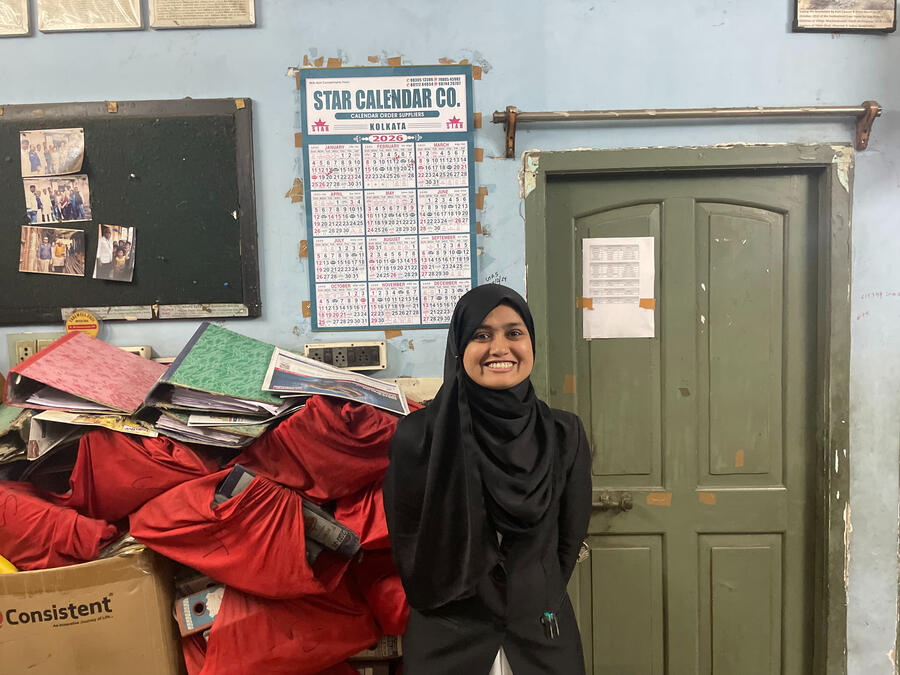
Afreen Tarannum's dream of becoming a lawyer would have never come true without Tiljala SHED. She now serves as an advocate on the Calcutta High Court, after having received personal tutoring for the bar exam by the head of the NGO.
Written by Connor Hocking, an American who spent a week in Kolkata volunteering with Tiljala SHED in February, 2026.You can contact Connor at [email protected]
Shatyam, one of Tiljala SHED's students, and Connor, the author.